
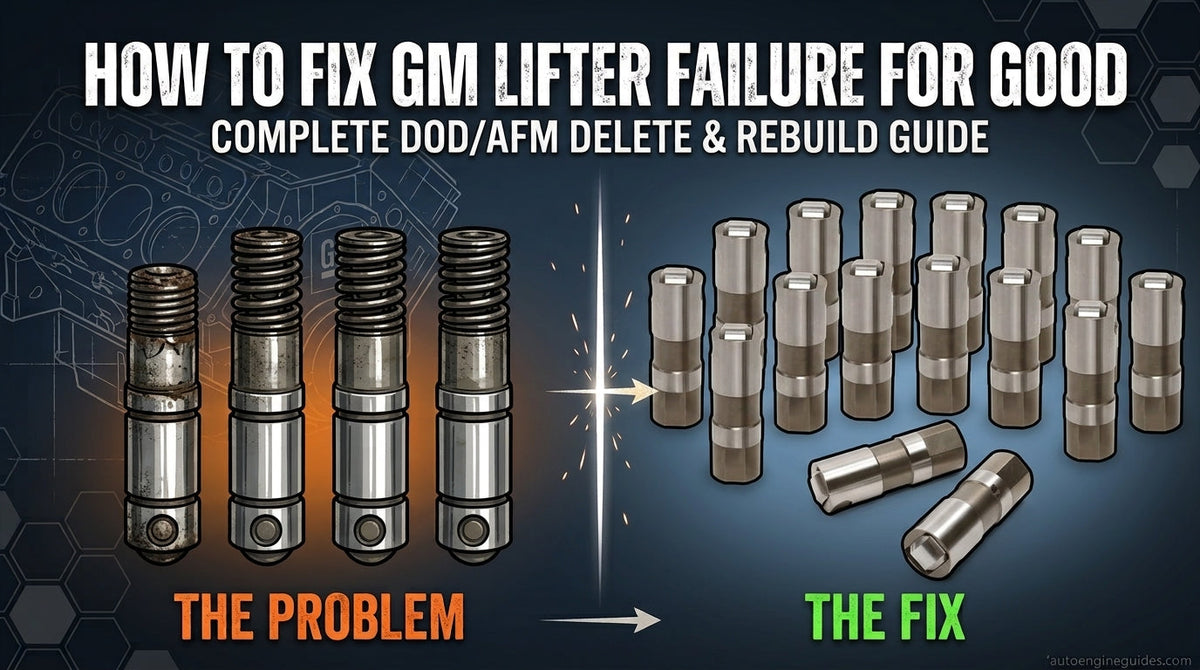
If you own a Gen IV GM truck, SUV, or performance car equipped with a 5.3L, 6.0L, or 6.2L V8, chances are high that you’ve heard about—or experienced—the infamous "GM lifter tick."
Displacement on Demand (DOD), also referred to as Active Fuel Management (AFM), was introduced by General Motors to boost fuel economy by shutting down four cylinders under light loads. While great in theory, the special collapsing mechanical lifters used in these systems are notorious for sticking, failing to pump up, or spinning in their trays—often wiping out the camshaft lobe and sending metal shavings through the entire engine.
When a DOD lifter fails, simply dropping in a replacement OEM lifter is a temporary band-aid. The permanent solution is a complete mechanical DOD/AFM delete and engine refresh.
In this guide, we break down what components you need, key assembly considerations, and how to delete the system once and for all.
Why a Software-Only "Tuner" Delete Is Not Enough
A common question in the GM community is: "Can’t I just turn off DOD/AFM with an electronic disabler or hand-held tuner?"
The short answer: No, not if you want long-term reliability.
An electronic disabler or tuner only prevents the ECU from triggering the solenoid block to deactivate cylinders. However, the physical, spring-loaded DOD lifters remain in your engine. Because these lifters have complex internal locking pins and oil passages, they remain a structural weak point prone to mechanical fatigue and failure.
To permanently protect your engine, you must perform a mechanical delete—replacing the lifters, lifter trays, valley cover, and camshaft with solid, proven performance components.
The Ultimate DOD/AFM Delete Checklist
When taking off the cylinder heads to remove failed DOD hardware, it’s the ideal time to perform a comprehensive top-end or full engine rebuild.
Here is what a complete, bulletproof DOD delete parts list includes:
-
16 Non-DOD Hydraulic Roller Lifters: Upgrade to proven LS7-style or heavy-duty hydraulic roller lifters.
-
4 Non-DOD Lifter Guides (Trays): Specially molded trays designed to keep standard lifters aligned properly.
-
Non-DOD Camshaft: DOD engine cams have unique lobe profiles on the deactivating cylinders. Replacing the lifters with standard units requires swapping to a non-DOD camshaft (such as an OEM spec 12689035 or an upgraded street performance cam).
-
Non-DOD Valley Cover Plate: Replaces the solenoid-heavy LOM (Lifter Oil Manifold) to properly seal off the oil risers in the block.
-
Complete Cylinder Head & Engine Gasket Set: Multi-Layer Steel (MLS) head gaskets, intake/exhaust gaskets, front cover seal, and new head bolts.
Builder's Tip: If your engine suffered a catastrophic lifter failure that damaged the cam lobe, inspect your bearings and cylinder walls carefully. We recommend installing an engine rebuild kit with upgraded main/rod bearings and fresh piston rings to clear out any residual debris.
Key Steps During Assembly
1. Block Preparation & Oil Passages
Once the original oil manifold and cylinder heads are removed, clean the deck surfaces thoroughly. Inspect the oil risers in the valley floor. The non-DOD valley cover plate uses high-temp O-rings or blocked passages to direct full oil pressure strictly to the main oil galleries, ensuring stable pressure to all 16 new lifters.
2. Lifter & Tray Alignment
Lightly coat your new hydraulic lifters in clean engine oil prior to assembly. Seat them into the non-DOD lifter trays, making sure the flat sides of the lifters line up smoothly with the slots in the tray. Torque the retaining bolts to factory specification.
3. Camshaft Installation & Piston Ring Check
If you are combining your delete with a full freshen-up, ensure your piston ring gaps and bearing clearances match your target specs. Apply high-tack assembly lube to the camshaft lobes and journal bearings before sliding the non-DOD cam into position.
Don't Forget: ECU Calibration Is Mandatory
Once the mechanical hardware is installed and the engine is reassembled, there is one final critical step: updating the ECU firmware.
Because the mechanical solenoids are no longer present, the factory ECU will trigger Diagnostic Trouble Codes (DTCs) and potentially put the vehicle into limp mode if AFM functionality isn't disabled in the software.
Using professional tuning software or sending your module to an experienced tuner allows you to:
-
Turn off all AFM/DOD diagnostic trouble codes permanently.
-
Adjust spark advance and fuel tables to match your new camshaft profile.
-
Optimize transmission shift points for smooth power delivery.
Ready to Delete Your DOD/AFM System?
Whether you're fixing a daily driver truck or building a high-horsepower street engine, doing the job right the first time requires matched, high-quality components.
We carry complete GM DOD/AFM Delete Kits and Engine Rebuild Kits, premium gaskets, and specialized coating services to keep your build running strong for thousands of miles.