
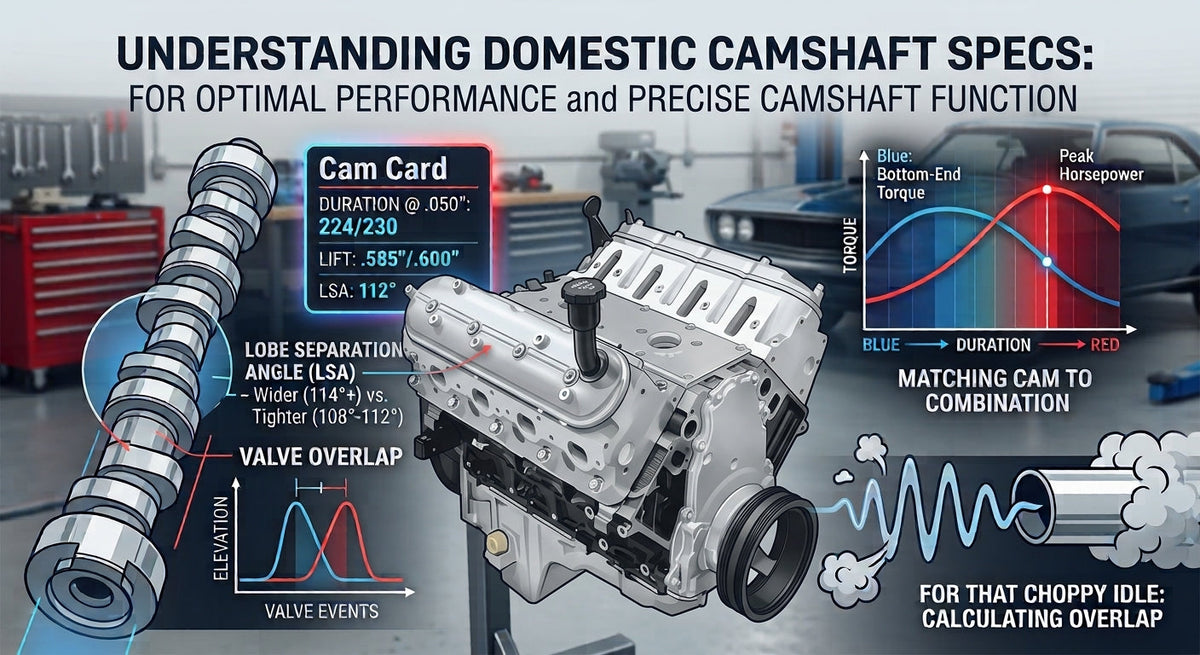
Whether you're building a street machine, a track beast, or a heavy-duty tow rig, few performance upgrades transform a domestic V8 quite like a camshaft swap. However, reading a cam card can feel like decoding a foreign language.
If you pick a grind solely based on a sound clip, you risk ruining your low-end torque, killing manifold vacuum, and ending up with a combination that’s miserable to drive.
This guide breaks down the core camshaft specifications, explains how they generate horsepower and torque, and reveals the exact formula for dialing in an aggressive, choppy idle without ruining drivability.
The Big Four: Core Camshaft Specifications Explained
To pick the right grind, you must understand how these four specs interact with your engine combination.
                <-- Lobe Separation Angle (LSA) -->

        Exhaust Peak                          Intake Peak
            /\                                    /\
           /  \                                  /  \
          /    \                                /    \
         /      \                              /      \
  ------/--------\----------------------------/--------\------ (0.050" Lift Line)
       <--Exhaust-->                        <-- Intake -->
        Duration                              Duration
1. Valve Lift
-
What it is: The physical distance (in fractions of an inch) the valve opens off its seat.
-
How it affects power: Higher lift allows more air and fuel to enter the combustion chamber.
-
The Trade-Off: Lift must match your cylinder head flow capabilities. Going past your head’s maximum airflow limit adds unnecessary stress to springs, pushrods, and valve guides without making more power.
2. Duration (Advertised vs. @ .050")
-
What it is: The time (measured in degrees of crankshaft rotation) that the valve remains off its seat.
-
Advertised Duration: Total degrees from the instant the valve leaves the seat to when it closes (measured at
.006"or.004"lift). -
Duration @ .050": The industry standard for comparing grinds. It measures duration after the valve has lifted
.050"off the seat, removing slow ramp profiles from the calculation. -
How it affects power:
-
Shorter duration (200°–218° @ .050"): Build higher cylinder pressure at low RPM, maximizing bottom-end torque. Ideal for heavy trucks and stock torque converters.
-
Longer duration (224°–240°+ @ .050"): Shifts the engine's breathing efficiency higher up the RPM band, trading off low-end grunt for top-end horsepower.
-
3. Lobe Separation Angle (LSA)
-
What it is: The angle (in crankshaft degrees) between the peak of the intake lobe and the peak of the exhaust lobe.
-
Wider LSA (114° – 118°): Spreads the intake and exhaust events farther apart. Produces a smoother idle, higher manifold vacuum, wider powerband, and better compatibility with forced induction (turbo/supercharger).
-
Tighter LSA (106° – 112°): Brings the intake and exhaust events closer together. Concentrates power into a punchier mid-range band but reduces idle stability.
4. Valve Overlap (The Sound Generator)
-
What it is: The time period around Top Dead Center (TDC) when both the intake and exhaust valves are partially open at the same time.
-
How it affects behavior: Overlap is the primary driver of both high-RPM scavenging and low-RPM idle chop.
How to Calculate Overlap for a Choppy Idle
That sought-after "lope," "chop," or "rumpty-rump" idle isn't created by lift or LSA alone—it is a direct byproduct of valve overlap.
When overlap increases at low RPM, exhaust gases dilute the incoming intake charge, causing temporary, rhythmic misfires that create the signature choppy exhaust note.
The Overlap Formula (@ .050")
To quickly find the degree of overlap using standard cam specs:
The Overlap Scale for Streetability
| Overlap Degrees (@ .050") | Idle Sound | Vacuum & Drivability | Stall Converter / Gear Requirement |
| Negative (-10° to -1°) | Smooth / Stock-like | Excellent vacuum; dead smooth | Stock converter; stock gears |
| Slight Positive (0° to +8°) | Mild Noticeable Chop | Good vacuum; minor surge at low RPM | Stock or mild stall (2,500 RPM) |
| Moderate (+9° to +18°) | Hard, Aggressive Chop | Moderate vacuum; noticeable surge | 3,000+ RPM stall; upgraded gears |
| Heavy (+19°+) | Race / Thumping Chop | Poor vacuum (needs vac pump/hydroboost) | 3,600+ RPM stall; deep rear gears |
Example Calculation:
If you are looking at a popular street performance grind with 228/232 duration @ .050" on a 111 LSA:
-
Average Duration: (228 + 232) / 2 = 230 Deg.
-
Double LSA: 111 x 2 = 222 Deg.
-
Calculate Overlap: 230 - 222 = +8Deg of Overlap
Result: This grind gives a clear, aggressive chop at idle while remaining tame enough for a weekend cruiser with a 2,800–3,200 stall converter.
How to Match a Camshaft to Your Engine Specs
A camshaft does not operate in a vacuum. To maximize usable power, align your cam choice with your vehicle's physical setup:

-
Static Compression Ratio:
-
Larger duration cams delay Intake Valve Closing (IVC), which bleeds off dynamic compression at lower RPMs.
-
If you run a big duration cam on a low-compression engine, it will feel sluggish down low. Higher static compression (10.5:1+) pairs best with longer duration grinds.
-
-
Torque Converter & Gear Ratios:
-
An aggressive cam (+10° overlap or higher) moves the powerband up to 3,000–6,500 RPM.
-
Running a large cam with a stock, tight torque converter will result in the engine pushing against the brakes at stoplights and bogging during acceleration. Match high-duration cams with a higher stall converter (3,000+ RPM) and deeper rear-end gears (3.73/4.10).
-
-
Naturally Aspirated vs. Forced Induction:
-
NA Engines: Benefit from tighter LSAs (108°–112°) and higher overlap to pull extra air through the intake during the scavenging phase.
-
Supercharged / Turbo Engines: Prefer wider LSAs (114°–118°) with zero or negative overlap. Excess overlap lets boost blow straight out the exhaust valve before it can build power in the cylinder.
-
The Golden Rule of Cam Selection
Don't over-cam your engine for sound alone.
Picking a cam that is too large for your cylinder heads, intake manifold, or torque converter will hurt driveability, kill off-the-line performance, and cause tuning issues.
Always select a camshaft that matches where your vehicle spends 80% of its time. If it's a daily driver or street cruiser, prioritize low-to-mid range torque over peak high-RPM horsepower.