
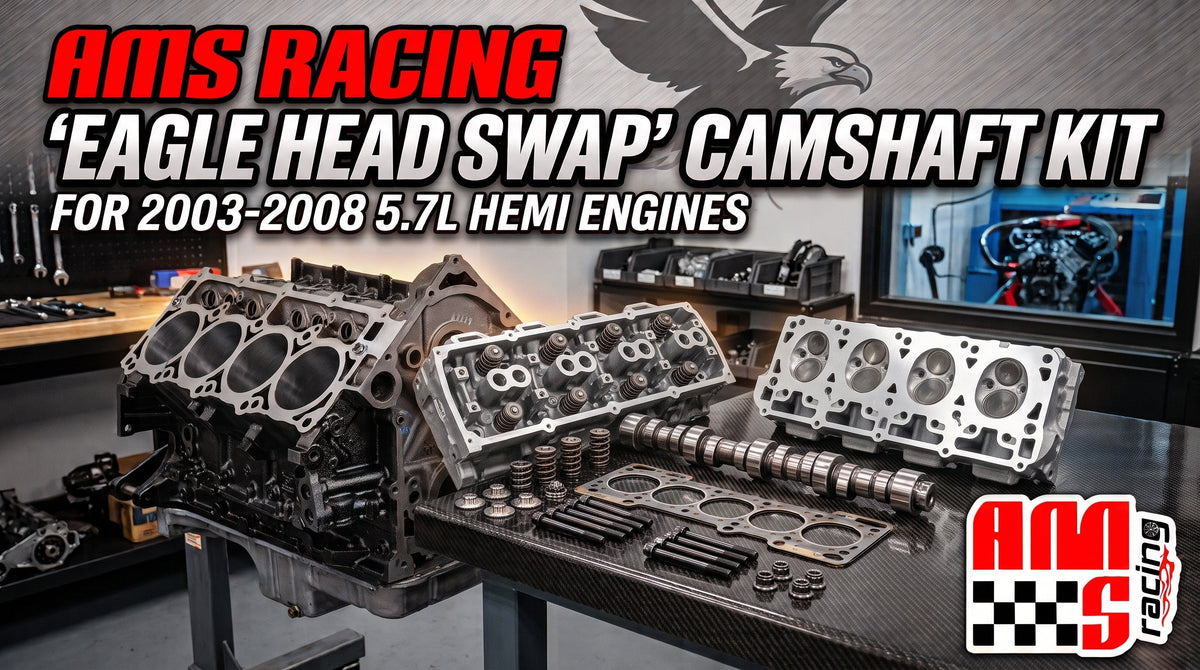
If you own a 2003 to 2008 Chrysler, Dodge, or RAM vehicle equipped with the 5.7L Gen III Hemi, you already know the platform is capable of making serious power. However, if you are looking to push past basic bolt-ons, the factory early 5.7L cylinder heads are the primary bottleneck choking your engine’s efficiency.
The solution that has become the gold standard in the Hemi community is the Eagle Head Swap—installing revised 2009+ factory 5.7L ("Eagle") cylinder heads onto an early 2003–2008 non-VVT block.
Here is why this modification is one of the highest-yielding, most cost-effective upgrades you can perform on an early Hemi build.
1. Massive Increases in Airflow
The biggest limitation of pre-2009 5.7L cylinder heads is their restrictive intake and exhaust port geometry. When Dodge revised the 5.7L engine in 2009 (codenamed the "Eagle"), they incorporated flow technology derived from the performance-focused 6.1L SRT8 Hemi.
-
Larger Valves: Factory intake valves jump from 1.92 inches on early heads up to 2.05 inches on Eagle heads, paired with larger 1.57-inch exhaust valves.
-
Redesigned Ports: Eagle heads feature significantly taller intake ports and D-shaped exhaust ports, allowing air to move smoothly with far less turbulence.
-
Flow Rates: Stock Eagle heads out-flow stock early 5.7L heads by roughly 40 to 50+ CFM right out of the box, offering flow numbers that rival ported aftermarket heads.
2. Big Power Gains Without High Aftermarket Costs
Dollar-for-horsepower, the Eagle head swap delivers unmatched value compared to buying expensive aftermarket aluminum heads.
-
Instant Dyno Gains: A baseline Eagle head swap typically yields 30 to 50+ horsepower gains on a stock-bottom-end 5.7L engine.
-
Cost-Effectiveness: Because Eagle heads are widely available factory castings, you get modern flow dynamics without paying the premium of custom CNC race heads.
3. Superior Combustion Efficiency & Knock Resistance
Engine technology advanced rapidly between 2003 and 2009. The Eagle cylinder heads featured a reworked combustion chamber layout and squish area designed to optimize flame propagation.
-
Cleaner Burn: The refined chamber design burns fuel more efficiently, translating to sharper throttle response and better power delivery.
-
Detonation Prevention: Improved cooling jacket routing and efficient chamber shapes reduce hot spots, providing better resistance to engine knock (detonation) under heavy load or boost.
4. Unlocks the Potential of Performance Camshafts
Installing an aggressive, high-lift camshaft into an early 5.7L Hemi with factory heads is like trying to run a sprint while breathing through a straw—the heads simply cannot flow enough air to reward the extra valve lift.
When you pair an Eagle head swap with a dedicated Eagle Swap Camshaft Kit, the performance synergy is dramatic:
-
The larger ports allow high-lift camshaft profiles to move massive amounts of air in the mid-to-high RPM range.
Key Considerations for the Swap
Because the 2009+ Eagle heads use revised port shapes and deck geometry compared to 2003–2008 engines, a proper conversion requires a few matching components:
-
Eagle-Style Intake Manifold: Early intake manifolds will not seal against the taller Eagle intake ports (requiring a 2009+ intake manifold or adapter plates).
-
Custom-Length Pushrods: Valve stem heights differ between early and late heads, requiring specific pushrod lengths to set proper valvetrain geometry.
-
Non-VVT Eagle Swap Camshaft: Early blocks do not have Variable Valve Timing (VVT), so a custom camshaft engineered specifically to run Eagle heads on a non-VVT engine is mandatory for optimal tuning and clearance.
Upgrading to Eagle cylinder heads modernizes your early Hemi, providing room for growth whether you stay naturally aspirated or plan to add forced induction down the road.